
Showing posts with label Betty's Baking Secrets. Show all posts
Showing posts with label Betty's Baking Secrets. Show all posts

Its now Great British Bake Off Season here in the UK, and in honor of that each week Betty's will be sharing a delicious recipe, plus a video and their baking tips to go with each recipe. The kind of thing you won't find in any cookery book! Here is week Nine of their delicious hints and tips and recipe.
SACHER TORTE, the Betty's Way Part Two
SPECIAL EQUIPMENT
1 X 15 cm deep baking ringINGREDIENTS
For the chocolate glacage (Mirror glaze):50g caster sugar (1/4 cup fine sugar)
100g liquid glucose (1/4 cup)
50ml water (scant 1/4 cup)
220g dark chocolate (8 ounces)
100g butter, chilled and diced (7 TBS)
for the Torte:
50g apricot jam (1/4 cup)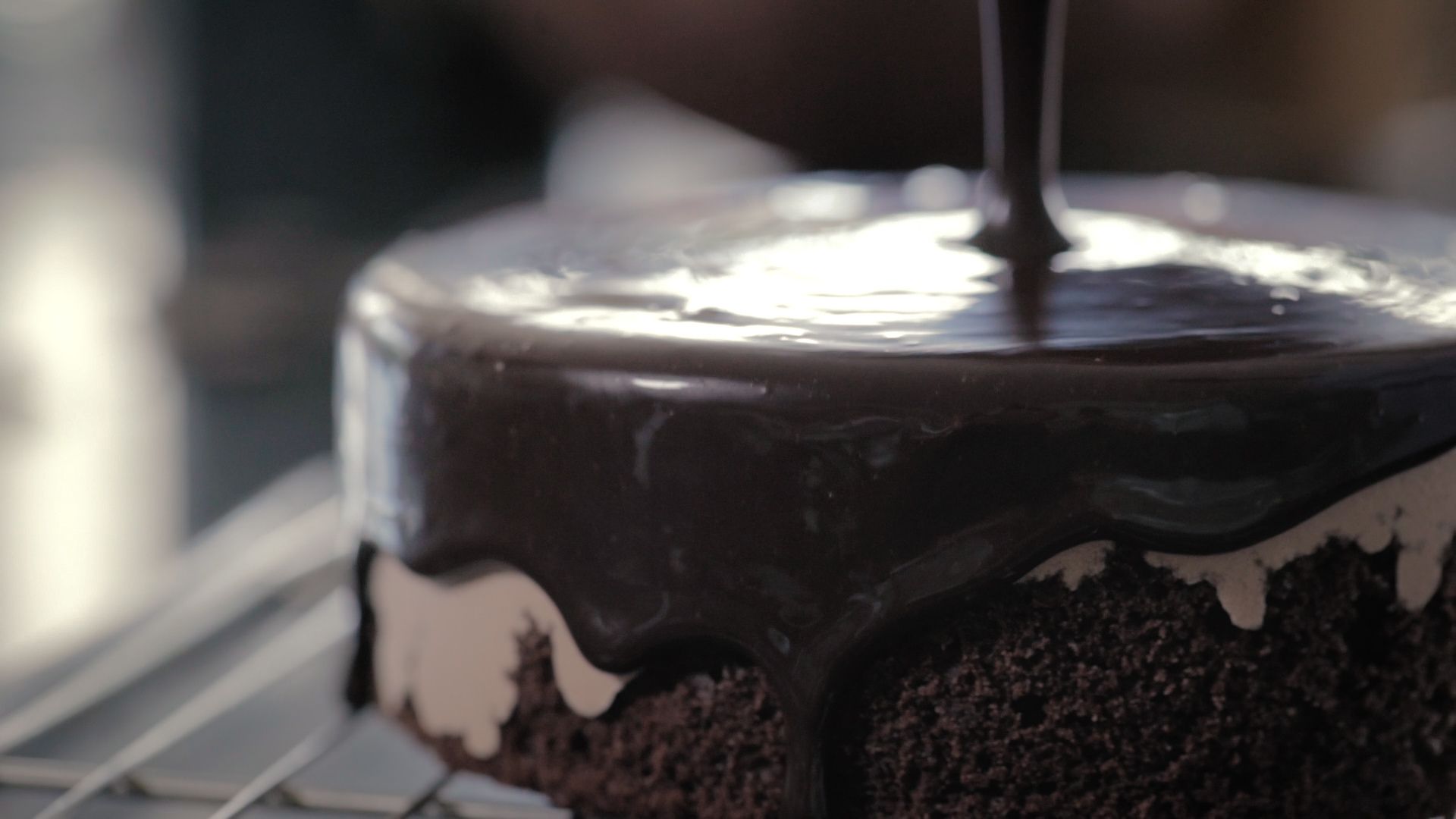
METHOD
In a heavy based pan, bring the caster sugar, liquid glucose and water to the boil until all the ingredients have dissolved into a syrup.Take off the heat, add the chocolate and the butter to the syrup and stir until completely dissolved to achieve a glossy finish.
Assemble the torte by slicing the sponge in half horizontally. Tyrn upside down so the flat base becomes of the top of your torte.
Spread all the apricot jam over the middle of sponge, then add 2 to 3 TBS of the chocolate glacage before sandwiching together.
Place in th baking ring.
Now to press it down. Cover the torte with a sheet of baking parchment and place a large pan on top of it. Place some tin cans inside the pan for extra weight.
Place in the refrigerator, wighted down, for 2 hours, or ideally overnight.
To fnish the torte gently reheat the remaining glacage over a low heat until it's fluid, but not too runny.
Remove the pressed torte from the baking ring.
Place the rote on a cooling wire with a sheet of paper beneath the wire.
Pour the glacage over the torte, allowing it to flood naturally over the top and sides. Leave to partially set for 15 minutes.
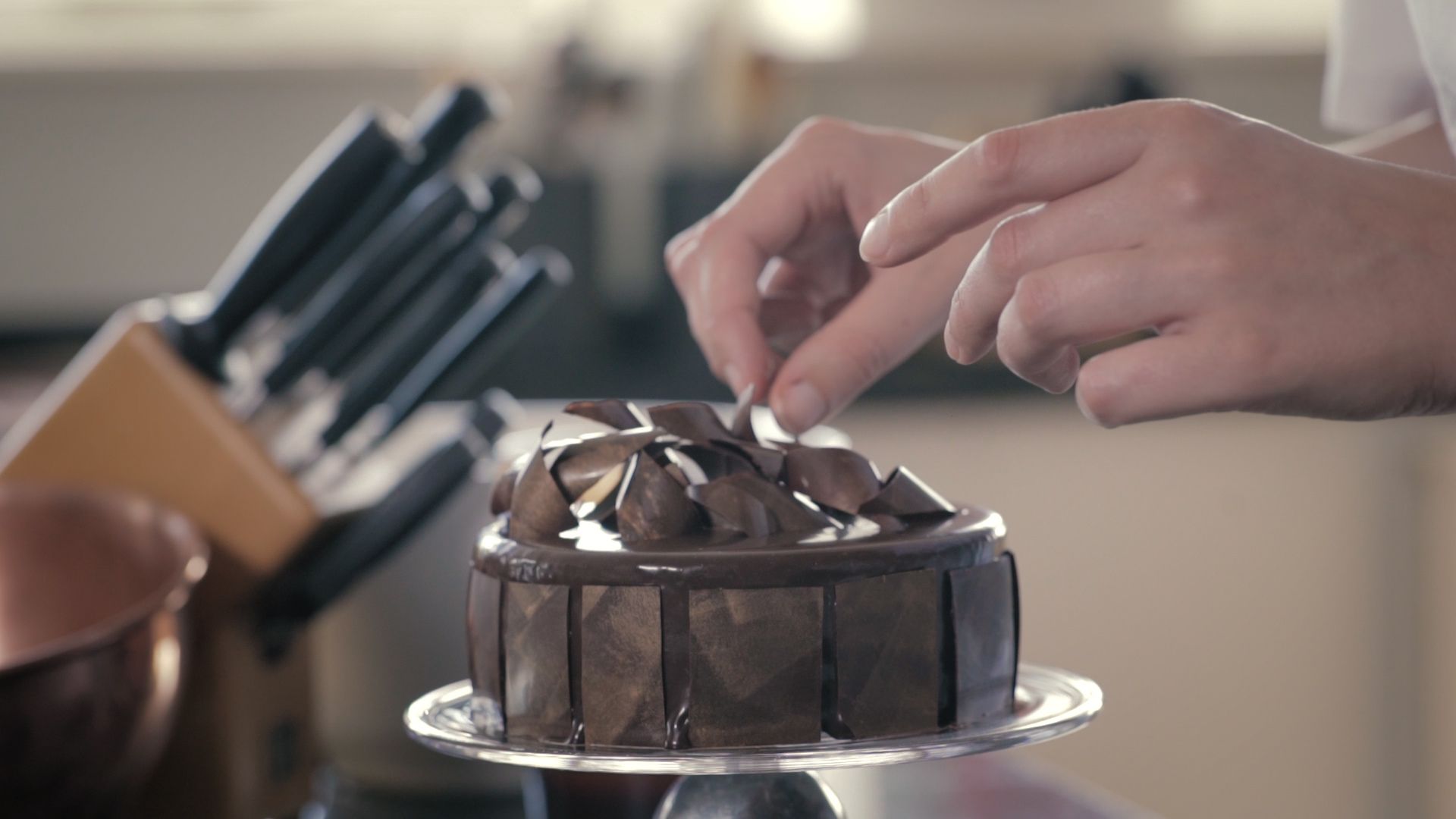
Use the excess chocolate glacage from beneath the cooling wire to fill a piping bag, then pipe the word Sacher onto the top of the torte. Leave to set.
NOTES IN THE MARGINS
Tempering Dark ChocolateCHOCOLATE'S IN CHARGE
Make sure you're feeling happy and relaxed - it's a delicate task which can be affected by a bad mood! As we like to say, "Chocolate's in charge".Switch off your phoe and prepare your working area fully. You won't have time to move things around or respond to calls.
Be aware that the weather can afect your chocolate work. It's very sensitive to temperature.
IT HAS A MEMORY
Chocolate has a memory - it will take on the qualities of the surface it touches. A shiny surface makes a shiny chocolate, so use a glass bowl to warm the chocolate.Glass it good for another eason: cereamic and metal are better conductors of heat and can over-heat the chocolate.
If using a bar, break the chocolate ino similar sized pieces so they melt easily.
Use more chocolate than you need. The larger volume means it changes temperature more slowly, giving you more time to work with it at specific heats.
NEARLY THERE IS THERE ENOUGH
Create a bain marie with a couple of centimetres of water simmering in a pan under the glass bowl. Don't let the water touch the bottom of the bowl.Work the chocolate with the back of a wooden spoon against the bowl.
Keep checking the temperature, but make sure your thermometer doesn't touch the surface of the bowl itself, or the temperature measurement may be wrong. Keep it moving around the chocolate, as some spots can be hotter than others.
Heat to 45-48*C, but remember - nearly there is there enough. Take it off at around 39-40*C as the temperature will continue to rise. If it does need a little more heat, use the bain marie in ten second bursts to stay in control.
WORK IT
Now bring it down to a tempered temperature of 25-27*C.Work the chocolate by movvin it around on a flat surface, gradually taking the temperature down. A marble or granite surface is best. Plastic or wood can dull the chocolate, so avoid that if possible.
When the chocolaate reaches 25-27*C, scoop it back into the bowl, place back over the bain marie and take it back up to 29-31*C. It's now ready to use.
Come back next week for the final part of our recipe for Sachertorte and to find out how to use your tempered chocolate to create stylish decorations. For more Betty's Baking Secrets visit www.bettys.co.uk/baking-secrets
Its now Great British Bake Off Season here in the UK, and in honor of that each week Betty's will be sharing a delicious recipe, plus a video and their baking tips to go with each recipe. The kind of thing you won't find in any cookery book! Here is week Eight of their delicious hints and tips and recipe.
Sachertorte The Betty's Way
Part One
SPECIAL EQUIPMENT
1 X 15 cm deep baking ring
INGREDIENTS (Serves 6)
3 eggs (medium) separated
100g caster sugar (in two equal measures of 50g each) (two measures of 1/4 cup each)
100g of dark chocolate (3 1/2 ounces)
75g butter (5 1/2 TBS)
50g caster sugar (1/4 cup)
METHOD
Preheat the oven to 170*C/325*F/ gas mark 3. Line the base of the baking rign with a disc of baking paper, large enough to cover the base and outside of the ring. Scure the parchment paper by twisting the paper around the outside of the ring.
Separate the three eggs. Place the egg whites into a large, clean metal bowl and the egg yolks into a measuring jug.
Using an electric whisk, whisk the egg whites to the soft peak stage. Gradually add the first measure of caster sugar, beating well until you achieve soft meringue. Set aside.
Melt the chocolate over a pan of simmering water. Ensure the condensation from the side of the bowl does not come into contact with the melting chocolate or else the chocolate may seize.
When the chocolate has melted remove from the heat and set aside to cool.
In a large mixing bowl, cream together the butter with the second measure of sugar until pale and fluffy. Gradually add the beaten egg yolks, being careful to avoid the mixture from curdling.
Beat in the cooled melted chocolate, using a metal spoon fold in the plain flour.
Fold in the meringue in three additions, making sure it is thoroughly combined.
Spoon into the prepared baking ring. Bake in the preheated oven for 25 to 30 minutes or until well risen and a skewer inserted into it comes out clean.
Leave in the tin for 15 minutes before turning onto a ire rack to cool compltely.
Our Sachertorte recipe will be continued next week, along with expert tips about tempering chocolate.
NOTES IN THE MARGINS
Magical Meringue
THREE BOWL TRICK
Separate the eggs using the three bowl method.
A metal bowl will help you creat volume in your mix.
Make sure that it is immaculately clean.
THE KITCHEN HELPER
Always place a damp cloth under the bowl to hold it still. We call it your "kitchen helper".
Set your mixer to a slow speed at first. This will expand the egg white to break down the protein.
WORK THE BEATERS
Esure you work with the beaters around the entire bowl ... don't simply stay in one place.
If the mix droops off the beaters it isn't ready as its too soft to hold the dense sugar.
It it starts to look like cotton wool you've already gone too far.
DON'T OVERWORK
Over-worked meringue will collapse and will be very difficult to fold in.
When the mix forms into firm peaks as you lift the beaters it is ready. Stop now.
Add the sugar gradually to ensure a smooth glossy meringue.
For more Bettys Baking Secrets, including recipes for Swiss Roll and Soft White Bread Rolls and handy tips for piping, visit www.bettys.co.uk/baking-secrets
Its now Great British Bake Off Season here in the UK, and in honor of that each week Betty's will be sharing a delicious recipe, plus a video and their baking tips to go with each recipe. The kind of thing you won't find in any cookery book! Here is week Seven of their delicious hints and tips and recipe on how to make a really fabulous finger biscuits!
Finger Biscuits
the Bettys Way
INGREDIENTS
100g butter, softened (7 TBS)
100g caster sugar (1/2 cup)
1 medium egg, beaten
1 - 2 drops vanilla extract
150g plain flour (1 cup plus 2 TBS)
1/2 tsp baking powder
zest of one lemon
METHOD
Preheat the oven to 175*C/325*F/ gas mark 3.
In a large bowl, use a spoon and sugar to cream the butter and sugar together until pale and fluffy. Gradually add the beaten egg and vanilla. Fold in the flour, baking powder and lemon zest to form a thick paste.
Line a baking tray with baking parchment and pipe the mixture into finger shape pieces, ensuring you leave plenty of space between each biscuit.
Bake in a preheated ovn for 6 to 8 minutes until light golden brown in colour. Cool on a wire rack. The biscuits will firm on cooling.
NOTES IN THE MARGINS
Fantastic Finger Biscuits
SHELL TRICKS
- Place a cloth under the bowl, its your second pair of hands.
- Cream the buscuit mixture with a spoon to present too much air entering the mix.
- If you get eggshell in your mix, use a half of eggshell to draw it back in.
- Whisk the egg thin so it can be added in three small additions.
- Once the mixture has drunk in the egg, it starts to stick to the bowl. Time for the next addition.
- As you get towards the last addition of egg, add less.
- Keep scraping the mixture into the middle to create a mass.
- If the mix starts to look siny and greasy and no longer clings to the bowl, you may have added too much egg.
BEST ZEST
- Wash lemon in cold water to remove wax but not the essential oils.
- Citrus should always be at room temperature to increase yield of juice and the fragrance from the essential oils beneath the zest.
- Scuff citrus in one direction on microplae. Otherwise it damages the microplane.
- Don't take the 'pith' . . . it changes its flavour profile.
- Cut the flour into the butter mixture with yoru pastry cutter.
- Bring the dough together with your hands . . . the warmth will help bring it together.
ROPEY PIPING
- When line piping, allow mix to fall from the piping bag drop like a piece of rope, rather than dragging it.
- If your mixture is quite firm, soften it with a few drops of water.
- If you're not sure how many biscuits will fit in your tray, test-bake one and see how far it travels.
- Space biscuits so that they colour evenly.
- If baking more than one batch on the same tray, cool down your tray in between bakes.
BOTTOMS UP
- Biscuits Bake from the bottom up so check the underside to see if they are ready.
- When you take them out of the oen, don't take them straight off the tray. They're still baking as they are cooling.
- Leave for five minutes on a cooling wire so air still circulates. Otherwise, soggy bottom!
- If your biscuits go stale, pop them back in the oen for five minutes to perk them up.
- Store them in an airtight tin with a few sugar cubes to retain crispness.
For more Bettys Baking Secrets, including recipes for Swiss Roll and Soft White Bread Rolls, and handy tips for piping, visit www.bettys.co.uk/ bettysbakingsecrets
Its now Great British Bake Off Season here in the UK, and in honor of that each week Betty's will be sharing a delicious recipe, plus a video and their baking tips to go with each recipe. The kind of thing you won't find in any cookery book! Here is week Six of their delicious hints and tips and recipe on how to make a really super Swiss Roll!
Super Swiss Roll
INGREDIENTS (serves 6-8)4 eggs (medium)
100g caster sugar (1/2 cup)
100g plain flour (3/4 cup)
½ tsp baking powder
¼ tsp bicarbonate of soda
150g strawberry jam (about 1 cup)
200ml double cream, lightly whipped (3/4 cup)
Caster sugar (for sprinkling)
METHOD
1. Preheat the oven to 200°C (fan assisted). Grease and line the base and sides of a baking tray with baking parchment. Sprinkle caster sugar over the paper.
2. Beat the eggs and sugar in a large mixing bowl over a saucepan of simmering water until thick and creamy.
3. Remove the bowl from the heat and continue beating until the mixture is cool and forms a figure of eight when the beaters are lifted out of the bowl.
4. Sift the self raising flour into the bowl and with a metal spoon quickly and carefully fold into the mixture.
5. Spoon into the prepared baking tray. Place in the preheated oven and bake for 8-10 minutes, until golden and ‘springy’ to the touch. Remove from the oven and leave for 5 minutes.
6. Place a clean tea-towel on the bench and top with a piece of baking parchment. Turn the sponge onto the baking parchment. Carefully remove the baking parchment from the sponge.
7. Roll up across its width enclosing the baking parchment as you go. Place on a wire rack and leave to get cold.
8. Unroll the sponge and spread with the strawberry jam and the whipped cream. Re-roll. Trim the edges. Dust with sifted icing sugar.
NOTES IN THE MARGINS
Super Swiss Roll
ZONE THE MIX Use a glass bowl - it’ll keep the batter at the right temperature. Whisk until you’re able to make a full figure of eight in the mix. Use a large metal spoon – the flattest you have. Hold your baking paper in place with few dots of mixture. Don’t pour the mix – ‘zone’ it and then join the mixture together for an even covering.MAKE ITS MEMORY Invest in an oven thermometer for accurate temperature readings. Sprinkle sugar on some baking paper so your sponge doesn’t stick to it. To release the sponge from the paper it was baked on, wet your hands and massage the back of the paper. Score a little wedge in the sponge and roll it to make its ‘memory’. Do this while it’s warm – it will remember that form and roll more easily later. Allow to cool. See the recipe card for Bettys Baking Secrets Week Three, Perfect Piping, for our tips about whipping cream.
CHEF’S PERK Apply your jam first – it’s a barrier to the cream which can dissolve your sponge. Loosen your jam by working it with a teaspoon so it spreads more freely and doesn’t tear the sponge. Zone it and join the dots (like you did with the sponge mix) for an even spread. Don’t spread to the edge – it will spill out when you roll. Whenever cutting cake use a serrated knife – saw and let the knife do the work. Remove the ends for a neat presentation – they’re the chef’s perk!
For more Bettys Baking Secrets, including our own recipes and secret tips for piping, visit www.bettys.co.uk/bettysbakingsecrets.
Its now Great British Bake Off Season here in the UK, and in honor of that each week Betty's will be sharing a delicious recipe, plus a video and their baking tips to go with each recipe. The kind of thing you won't find in any cookery book! Here is week five of their delicious hints and tips, and week four on how to create a delicious Croquembouche.
NOTES IN THE MARGINS
Sparkling Spun Sugar, The Betty's Way
Make a Mess
Create Spun Sugar in a friend's kitchen.
Why? It's messy
Golden Syrup
Temperature is important
It mix is too cold, the strands will be too thick. If too hot, they will be too thin.
The ideal consistency is like warm Golden Syrup.
Stand Up Tall
You'll need a little height to work with the sugar. (In the film, Lisa is stood on a kick stool!)
Don't make it too early, it will only last for an hour or so.
Cleaning Up
Cleaning up can be tricky, but not if you do this: Fill the pan with water, bring it to the boil, then tip it away.
Sparkling!
If only washing up was so easy.
This is the final part of our series about how to create a Croquembouche. Find out how to create spun sugar to decorate your masterpiece in next week's episode of Betty's Baking Secrets.
www.bettys.co.uk/bettysbakingsecrets
Its now Great British Bake Off Season here in the UK, and in honor of that each week Betty's will be sharing a delicious recipe, plus a video and their baking tips to go with each recipe. The kind of thing you won't find in any cookery book! Here is week four of their delicious hints and tips, and week three on how to create a delicious Croquembouche.
Cracking Caramel, the Bettys way
INGREDIENTS (makes approximately 300ml)
75ml water
145g caster sugar
60g glucose syrup
METHOD
1. Place the ingredients in a small, heavy base saucepan and set over a medium heat.
2. Stir with a wooden spoon until the sugar has dissolved and then increase the heat to bring up to the boil. Do not stir anymore.
3. Brush the sides of the pan using a wet pastry brush to prevent grains of sugar getting stuck to the side of the pan. The grains of sugar may crystallize the syrup.
4. Boil until the syrup turns a light golden colour and stop the cooking process by briefly plunging the pan into a bowl of very cold water. Do take care as this is a dangerous process. The caramel is ready to use. If the caramel cools down and sets, place over a gentle heat to melt.
Notes in the Margins
Cracking Caramel
WET SAND
Your heavy base pan must be immaculately clean.
Keep some hanging water in the pan so the caramel doesn’t burn.
Use your finger to stir the sugar – create the texture of ‘wet sand’.
SWIRL
The glucose is a vital ingredient.
It keeps the spun sugar flexible later on.
Pick up the glucose with a wet hand so it doesn’t stick. Do this off the heat.
Once you introduce the caramel to the heat, don’t stir it - swirl.
GOLDEN BLONDE
You’ll see it go to a blonde caramel with a hint of colour.
Watch for it turning to a honeycomb, golden blonde – then remove from the heat.
Be careful – caramel is red hot! Let the choux touch the sugar – not your finger.
This is part three of our series about how to create a Croquembouche. Find out how to create spun sugar to decorate your masterpiece in next week’s episode of Bettys Baking Secrets. www.bettys.co.uk/bettysbakingsecrets
For nearly 100 years, people have been flocking to Yorkshire for a taste of Bettys. Bettys was founded by Frederick Belmont, a Swiss baker and confectioner who came to England in search of opportunities to develop his craft skills. He opened his first Café Tea Rooms in Harrogate in 1919 and named it 'Bettys'. The reason why remains a mystery to this day.
Wondrous Whipping the Bettys way
From whipping techniques to making use of leftovers, this is everything you need to know about dream cream.
- The higher the fat, the better the set, so if you’re hoping for a chocolate tart that serves up the perfect slice, choose double cream.
- Don’t heat single cream - it will split.
- Because of the fat content, cream whips better if very cold.
- If the weather’s warm, place the bowl and whisk in the fridge in advance.
- Always use a metal bowl – it will help you whip up the cream up quicker and the cream will hold its shape.
- Whip cream by hand so you can judge the thickness.
- When the cream begins to hold in the ends of the whisk, you’re just two to three turns from the perfect whip.
- Don’t over-whip cream as it will change the texture and cause a fatty mouth feel. Also, if you over-whip cream for a mousse or soufflé it will be very difficult to fold in, and will likely take air out and leave lumps behind. But if it is over-whipped, a few extra tablespoons of cream may fix it.
- Don’t bin leftover cream - freeze it. You can add it straight into a soup or sauce.
FOR REFERENCE
Average fat content of different creams:
1. Single cream: 18%
2. Whipping cream: 35%
3. Double cream: 48%
4. Clotted cream: 55%
5. Mascarpone: 60-75%
Notes in the Margins: Perfect Piping
NIP AND TUCK
Tuck the piping bag into the nozzle so mixture doesn’t drip out. Nip the bag between finger and thumb. Create pressure by twisting the bag. Pipe from the top so the mixture is pressured in one direction.
MATCHING CHOUX & HAT
Don’t pipe too close – the bun will be flat, like a beret. Don’t pipe it pointy, like a Dumbledore hat – it’ll burn. Aim for a mound that you twist into a rounded top – like the Sorting Hat from Harry Potter!
IN THE OVEN
Spacing is important – too close and they can’t bake. Arrange the small ones at the back and the big ones at the front so they bake evenly. Don’t take them straight out of the oven – you’ll get Yorkshire puddings. First open the door to release steam. Then shut the door and turn the oven off to allow the hanging temperature to create the crisp texture.
This is part two of our series about how to create a Croquembouche. Find out how to make Caramel in next week’s episode of Bettys Baking Secrets.
www.bettys.co.uk/bettysbakingsecrets
For nearly 100 years, people have been flocking to Yorkshire for a taste of Bettys. Bettys was founded by Frederick Belmont, a Swiss baker and confectioner who came to England in search of opportunities to develop his craft skills. He opened his first Café Tea Rooms in Harrogate in 1919 and named it 'Bettys'. The reason why remains a mystery to this day.
Lots of things have changed since then. They now have six Café Tea Rooms in Yorkshire and the Bettys name has become famous the world over. They have also added a mail order service which delivers deliciousness to homes from Tunbridge Wells to Tokyo, and they share their knowledge and passion for food through Bettys Cookery School.
But in other ways, they are unchanged. Still family-owned, they believe in doing business in a way that is fair to people and kind to the planet. And at their Craft Bakery in Harrogate they still practice the artisan skills that Frederick Belmont brought to Yorkshire from Switzerland nearly 100 years ago.
Its now Great British Bake Off Season here in the UK, and in honor of that each week Betty's will be sharing a delicious recipe, plus a video and their baking tips to go with each recipe. The kind of thing you won't find in any cookery book!
This week they sent me some delicious Fondant Fancies to enjoy eating while we enjoy watching the GBBO! I can't wait to get stuck in. They look delicious!
For nearly 100 years, people have been flocking to Yorkshire for a taste of Bettys. Bettys was founded by Frederick Belmont, a Swiss baker and confectioner who came to England in search of opportunities to develop his craft skills. He opened his first Café Tea Rooms in Harrogate in 1919 and named it 'Bettys'. The reason why remains a mystery to this day.
Lots of things have changed since then. They now have six Café Tea Rooms in Yorkshire and the Bettys name has become famous the world over. They have also added a mail order service which delivers deliciousness to homes from Tunbridge Wells to Tokyo, and they share their knowledge and passion for food through Bettys Cookery School.
But in other ways, they are unchanged. Still family-owned, they believe in doing business in a way that is fair to people and kind to the planet. And at their Craft Bakery in Harrogate they still practice the artisan skills that Frederick Belmont brought to Yorkshire from Switzerland nearly 100 years ago.
Its now Great British Bake Off Season here in the UK, and in honor of that each week Betty's will be sharing a delicious recipe, plus a video and their baking tips to go with each recipe. The kind of thing you won't find in any cookery book!
This week they are sharing their recipe for Classic Bread Rolls with us. After watching the video, I think even I will be able to bake us some lovely rolls!
*Classic White Bread Rolls*
the Betty's way
To Decorate:
20ml whole milk (1 12 TBS)
1 egg, beaten
selection of poppyseeds, sesame seeds, sunflower seeds
METHOD:
1.
Place the flour and salt together in a bowl. Rub the butter into the
flour using your fingertips until it is fully mixed through.
2.
Add the yeast to the milk and water and mix with a fork. Allow to
stand until the yeast has dissolved before adding this to the dry
ingredients.
3. Gradually add the liquid to the dry
ingredients, together with the dissolved yeast. Work the mixture
together until it forms a ball of dough, and tip ou tonto a work
surface.
4. Knead gently for about 10 minutes until the dough becomes soft and smooth.
5. Allow the ball of dough to rest under a slightly damp cklean tea-towel for 5 minutes.
6.
Roll the dough into a sausage shape first and, using the scraper,
divide th edough into 8 evenly sized pieces. Roll each into a round
shape. Allow the dough to relax again for five minutes under a damp
tea-towel or clingfilm before making each ball into a shape.
7. When the dough has been shaped, carefully place onto a baking tray.
8. Brush the dough with a little egg/milk mixture and sprinkle with seeds of your choice.
9. Place the tray in the prover or leave in a warm place covered with clingilm for about 20 minutes, or until doubled in size.
10.Bake the bread in a preheated oven at 200*C/400*F/ gas mark 6 (fan assisted) oven for 10 to 15 minutes, (depending on shape.)
11.The bread is baked when golden brown in colour and when tapped underneath they should sound hollow. Place on a cooling wire.NOTES IN THE MARGINS
~o~Beautiful Bread~o~
KNEADING
When kneading, always work the dough in the same direction. This will deveop the network of gluten strands.
To avoid sticking to your dough, use the one second contact rule - don't touch your dough for more than a second as you knead it
Imprint your dough with your thumb - if it springs back, its ready.
BALLLING OFF
This stage is really important - what you're trying to do is trap energy in the dough.
When Lisa holds up the underside of the balled off dough, you can see the swirls of the core - yet the top is smooth.
The movement you're looking for is down and over. Notice in our film how Lisa pushes slightly down and she rotates the dough in her palm, travelling in the same direction.
HOMEMADE PROVER
If you don't hav ea dedicated prover, few of us do, its easy to create one.
Simply take a bowl, turn it upside down in your sink, add hot water and your tray of dough, and cove rwith some cling fim.
Do you get tangled up in clingfilm? Than fold it back on itself to double line it - it prevents it from misbehaving!
FINISHING THE RACE
Allow the dough a final 10% to finish the race. In other words, remove the dough from the prover a little before it has completely risen.
This is because the yeast needs a last bit of energy to take into the oven for a perfect rice.
COOLING
When cooling your bread, make sure there's an airflor under the tray.
This prevents soggy bottoms!
Do check out the Betty's Baking Secrets Page, for a whole lot more baking secrets during the GBBO and beyond. Also don't forget to check back next week to see what's baking next! (With any luck I might even get it baked myself to show you my results! There is no rest for the wicked!!)
Subscribe to:
Posts (Atom)





Social Icons